In case you missed it: Part 1 of this series, When the Technology Has Gaps, People Fill Them
One night in Carlisle County, the sheriff was called out on a reckless driver. He made a traffic stop, but he never radioed his exact location, and then I lost contact with him. All I had was the general area.
Based on the geography of the call, I phoned two neighboring counties. I sent one unit heading north and the other heading south until we found him. He was okay. He also had seven people under arrest on the side of the road.
Both of those counties left their own areas that night to back up an officer who wasn't theirs. That's how it works in small communities. In an emergency, jurisdictional lines aren't a big deal. But every step of it ran on a phone call and a radio, and the clock was running the whole time.
At the console
Early in my career, I took a call for a death investigation that was beyond what our sheriff's department was equipped to handle. Investigators came in from several counties. We had no 911 addressing, so I repeated directions over and over, to every unit on the way, until they were all on scene.
Coordinating across agencies still works that way in a lot of places. In the first part of this series, I mentioned the agencies that can't share information electronically. With those, the dispatcher picks up the phone, explains what's happening, what's needed, and what the plan is. Then they do it again for the next agency. That can take 10, 15, 20 minutes.
The small things add up too. When a crash needs a tow truck, the dispatcher calls the first company and walks through the location and what's needed, only to hear they aren't available. That's close to a minute gone, and then it starts over with the next one.
And none of it happens in isolation. One incident doesn't mean everything else stops. The dispatcher is still answering new calls and deciding what comes first, all while holding the one on the phone.
"If I call for help, it may just be a minute or two. But when you're out there in the field, that minute or two seems like an hour."
In the field
On the other end of the radio, time moves differently. If I'm working EMS and I need backup, I'm waiting on a dispatcher who may be handling three other critical incidents I don't even know about.
Not long ago, I responded to a call in my own vehicle. The area was rural enough that my radio couldn't reach dispatch, and I had no way to let them know I was on scene. So I texted the dispatcher my status and an update on my patient for the ambulance on its way. If I'd had access to CAD from the field, I could have marked myself on scene and moved on to the patient.
What's possible now
It doesn't have to work this way. Agencies with modern systems can share an incident with a neighboring center in real time, so it lands directly on their map instead of being read out over the phone. When more personnel are needed, an alert goes out to everyone at once, rather than someone working down a phone list.
That's the difference between 20 minutes on the phone and a call that's already where it needs to be.
The minutes a system can't save don't disappear. They get spent by the dispatcher on the phone and by the responder waiting in the field. Both of them were already carrying something else.
If every agency around you could see the incident in real time, how many of today's phone calls would your team never have to make?
About the author
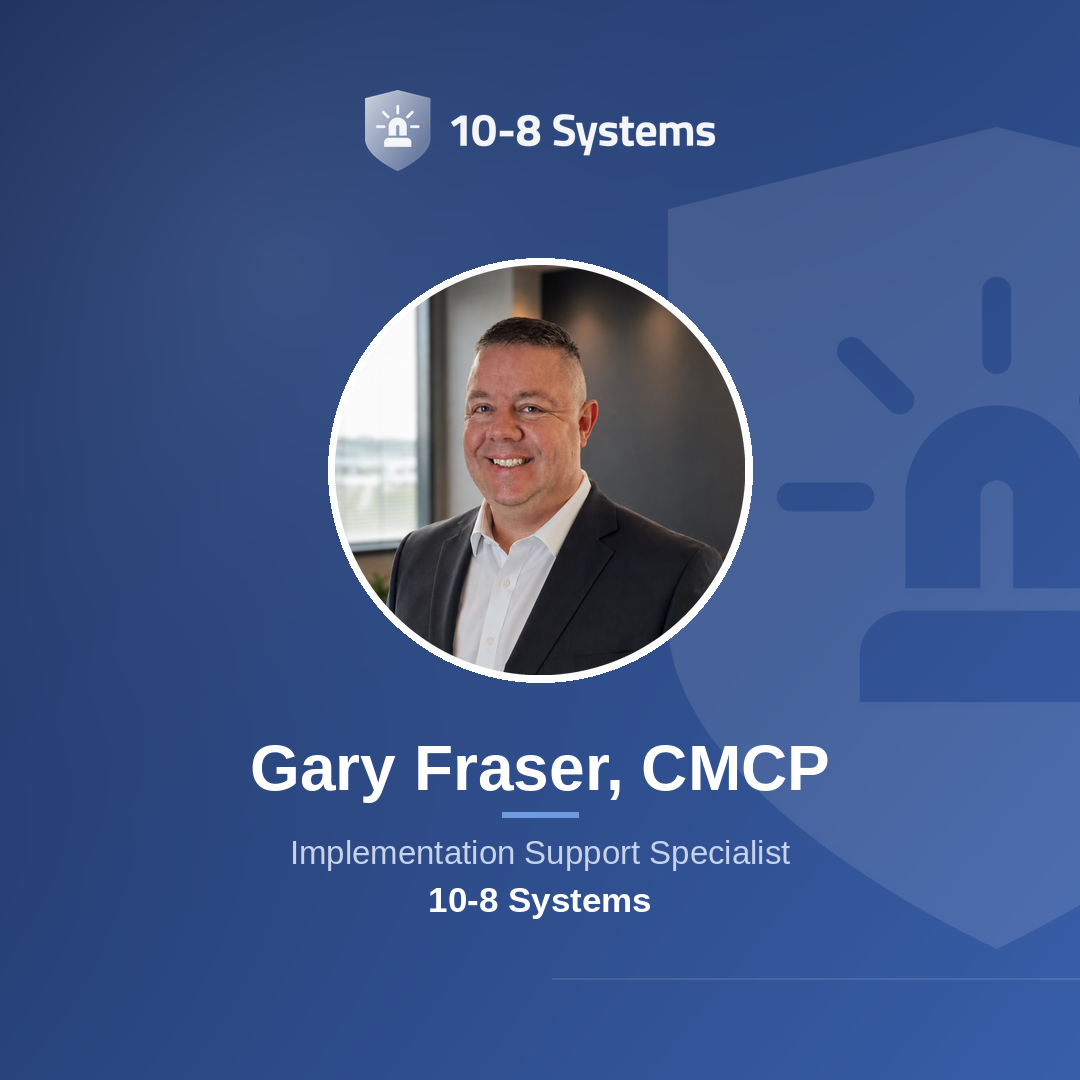
Gary Fraser, CMCP, is an Implementation Support Specialist at 10-8 Systems. He started dispatching at the Carlisle County 911 center in 1997 and spent 27 years as a Public Safety Telecommunications Manager with Kentucky State Police. He has worked as a part-time EMT with Carlisle County EMS since 1997 and completed a paramedic program in 2022.