Third in a three-part series. Part one: Between the AI Strategy and the 911 Console. Part two: Your CAD Runs on Deadlines You Don’t Set.
When it comes time to decide, the easiest choice is to keep what you have. No procurement, no implementation, no retraining. On this year’s spreadsheet, it looks like the responsible choice.
For a legacy CAD system, it usually isn’t. The costs of keeping it don’t disappear. They arrive later, in uneven amounts, and often at the worst possible time.
Budgets Shift. Costs Keep Coming.
In Euna Solutions’ 2026 survey of public procurement professionals, 55 percent reported budget cuts or flat funding, and 74 percent named rising costs as their top outside challenge. The 2026 Digital States Survey ranks budget and cost control among states’ top five technology priorities.
In that environment, a known cost this year can look riskier than an unknown one later. But the costs of keeping legacy CAD aren’t unknown, they’re just pushed down the road, and they come due when you least expect it: a failed server, a forced upgrade, an end-of-support date that can’t be moved.
The Hidden Costs of Keeping Legacy CAD
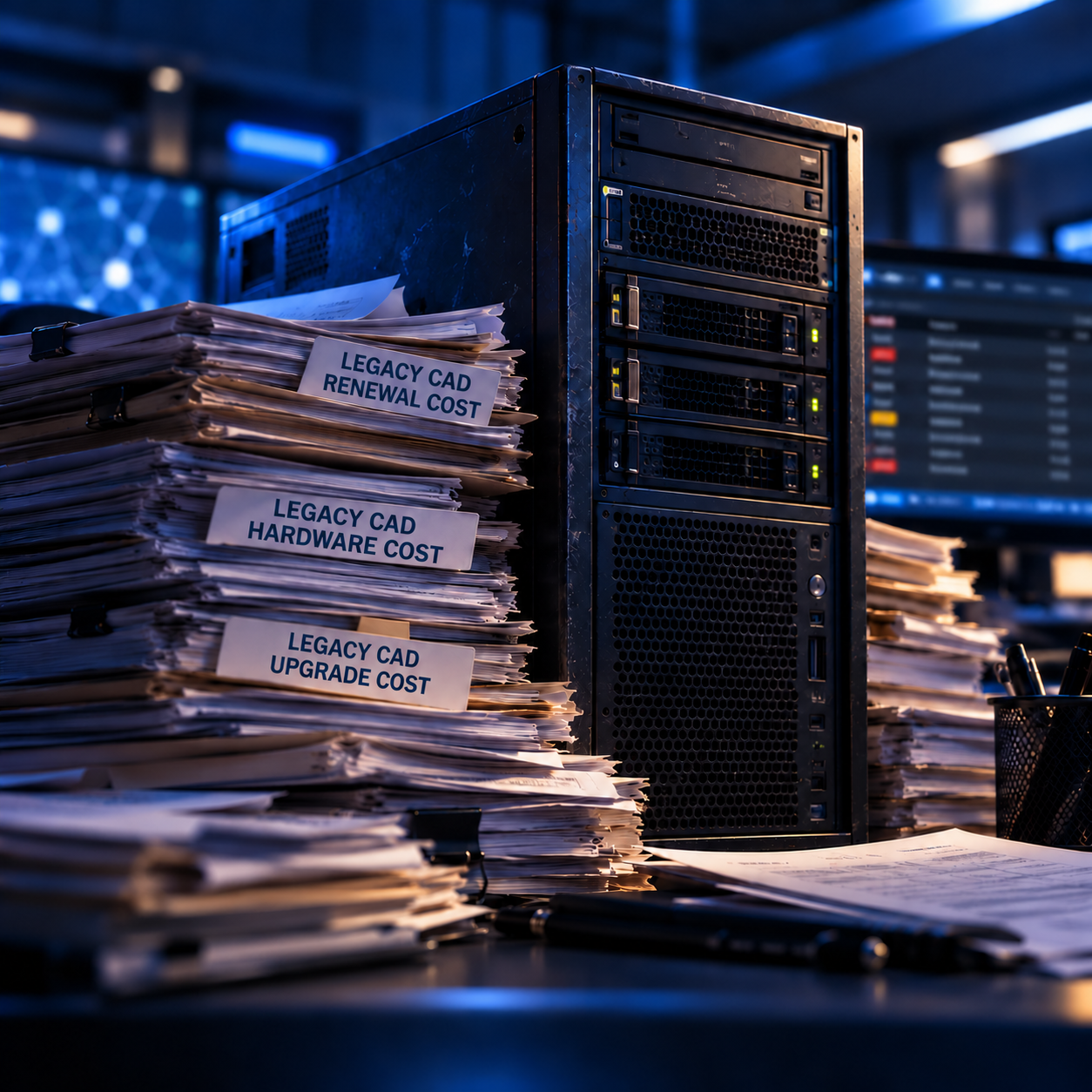
Hardware on a clock. Servers, storage, and backup equipment wear out, and they’re replaced at today’s prices.
Upgrade projects. Staying current often means a major upgrade every few years, with vendor services, testing, and overtime to cover the center.
Maintenance agreements. Support costs tend to rise every year, whether or not the system changes.
Staff time. Every hour spent patching CAD servers or planning around a maintenance window is an hour not spent somewhere else.
Workarounds. When a system wasn’t built for multi-agency work, information gets re-entered and coordination falls back on phone calls. Dispatchers pay that cost, one call at a time.
Recovery. If an incident takes down locally managed infrastructure, rebuilding it is an expense no budget planned for.
Future readiness. AI tools for dispatch, like transcription, translation, and call triage, need a system that shares data in real time. Legacy CAD can be made to work with them, but only through custom interfaces, middleware, and add-on contracts. The real cost isn’t buying the tool, it’s bolting it onto a system that was never built to take it.
None of these show up when the decision is framed as “keep it another year.” They show up later as emergency requests, the hardest kind to fund in a flat year.
Every Outside Deadline Becomes a Budget Line
Every outside change a CAD system has to keep up with eventually shows up as a cost.
When Microsoft ends support for Windows Server 2016 on January 12, 2027, an agency whose CAD still runs on it has two choices: replace the infrastructure, or pay each year for extended security updates. Neither was in this year’s plan. The same goes for changes to the 911 network, new security requirements, or a carrier retiring the network a fleet’s modems depend on. Each arrives with a cost and a date the agency didn’t choose.
Standing still is a decision too. It just sends the bill later.
What the Leading States Are Doing
The Digital States Survey offers a clear example. Iowa is moving off 36 data centers and 137 server closets onto cloud services and expects to save more than $525 million over ten years. Michigan is moving off its state mainframe.
Mississippi’s CIO, Craig Orgeron, described the goal in terms any public safety leader will recognize: building capabilities that “outlast any single funding cycle.”
The states pulling ahead judge their systems over a decade, not a budget year.
How to Compare the Real Cost of Legacy CAD
The true cost of a legacy CAD system is everything it takes to keep it running, current, and ready for what’s next: hardware, upgrades, support, staff time, recovery, and the cost of connecting it to new tools.
Most agencies ask, “Can we afford to replace our CAD this year?” A more useful question is, “What will it cost to keep our current system for the next five years, and when will those costs land?”
Answering it means pulling together the hardware refresh schedule, the next required upgrade, support contract terms, end-of-support dates, and an honest count of staff hours. Laid side by side, doing nothing means paying for the same system over and over: another hardware refresh, another upgrade, another contract increase, with no end in sight. Renewal fees can rise even as the hardware ages, so agencies pay more to keep the same system running while the next replacement bill gets closer.
Where 10-8 Systems Fits
10-8 Systems is cloud-native on AWS GovCloud, so there are no agency-owned CAD servers to buy, refresh, or rebuild. It’s continuously updated with no downtime, so staying current doesn’t require an upgrade project. Core CAD can be stood up in weeks not months. Agencies can buy directly or through AWS Marketplace, or through a variety of cooperative purchasing agreements.
Questions Worth Asking
Q: Is it cheaper to keep a legacy CAD system than to replace it?
A: Only if you look at one year. Over three to five years, a legacy system brings hardware replacement, at least one major upgrade, rising support fees, and the staff time to keep it running. Count all of that, and “keep it” is no longer the lower-cost option.
Q: What are the hidden costs of legacy CAD?
A: The ones agencies rarely budget for: servers that wear out or are no longer fit-for-purpose, upgrade projects, rising support fees, IT hours spent patching, dispatcher workarounds, recovery after an incident, and the cost of connecting new tools later. Each one is predictable. None of them are factored in when the decision is made to simply keep the system another year.
Q: How can an agency fund a CAD change?
A: Stop funding it as a one-time capital project. A cloud-native platform replaces large, uneven costs with a more predictable one. Agencies can buy 10-8 Systems directly or through AWS Marketplace, or through cooperative purchasing agreements, whichever fits their procurement process.
Q: How do we compare an on-premise CAD quote with a cloud-native subscription?
A: Start by checking what each price includes. An on-premise quote can look cheaper because servers, storage, backups, security maintenance, hardware refreshes, upgrade services and internal staff time sit outside the software price. Workarounds and recovery add costs too. Compare both options over the same five-year period, including what it takes to keep each system current, connected and available. A lower software price can still leave the agency with a higher total bill.
Q: What should we ask our current CAD vendor about future costs?
A: Request four responses, in writing:
- When does our version reach end of support?
- What does the next required upgrade cost, and how long will dispatch be affected?
- How much will maintenance fees rise over the rest of the contract?
- What hardware will we need to replace, and when?
If the answers are vague, that’s a good sign the next five years will cost more than you’ve budgeted for.
Want to know what keeping your current CAD will cost over the next five years? Talk to us, and we’ll help you put the numbers side by side.
Talk to 10-8 Systems